


Overview
Artificial intelligence (AI) has moved quickly from an academic field to a core technology shaping the global energy sector. As energy systems respond to digitalisation, decarbonisation, decentralisation, and deregulation, AI is increasingly used to manage rising system complexity at scale (IEA, 2025[1]).
Across the energy value chain, AI is being applied to:
- Analyse large, heterogeneous datasets
- Identify patterns that are difficult to capture with traditional methods
- Support real-time operational and strategic decision-making.
Recent assessments suggest that the broad deployment of commercially available AI applications could generate annual cost savings exceeding US$200 billion by 2030 (Deloitte, 2025[2]). , alongside substantial energy efficiency gains and emissions reductions. This potential is strengthened by a long track record of AI research and deployment in the power sector (Heymann, F., Quest, H. et al., 2024[3]).
From Expert Systems to Deep Learning and Into Today’s Energy Systems
AI didn’t suddenly arrive in the energy sector. It’s been there, in one form or another, for over forty years (Heymann, F., Quest, H. et al., 2024[3]). Early applications in the 1980s-1990s centred on expert systems and rule-based approaches, with landmark reviews in 1989 and 1997 cataloguing their use in power system control, diagnostics, and planning (Schneider Electric, 2024)[4]. These systems laid the groundwork for the more sophisticated approaches that followed.
Things changed dramatically from the 2010s onwards (Deloitte, 2025[2]). Progress in:
- Machine Learning (ML)
- Deep Learning (DL)
- Reinforcement Learning (RL)
Combined with falling compute costs, this pushed AI from theory into everyday operational use. (Heymann, F., Quest, H. et al., 2024[3]). At the same time, the rapid rollout of smart meters, sensors, and distributed energy resources created something the earlier generations lacked: data at scale. That data made it possible to move beyond handcrafted rules and start learning directly from real system behaviour.
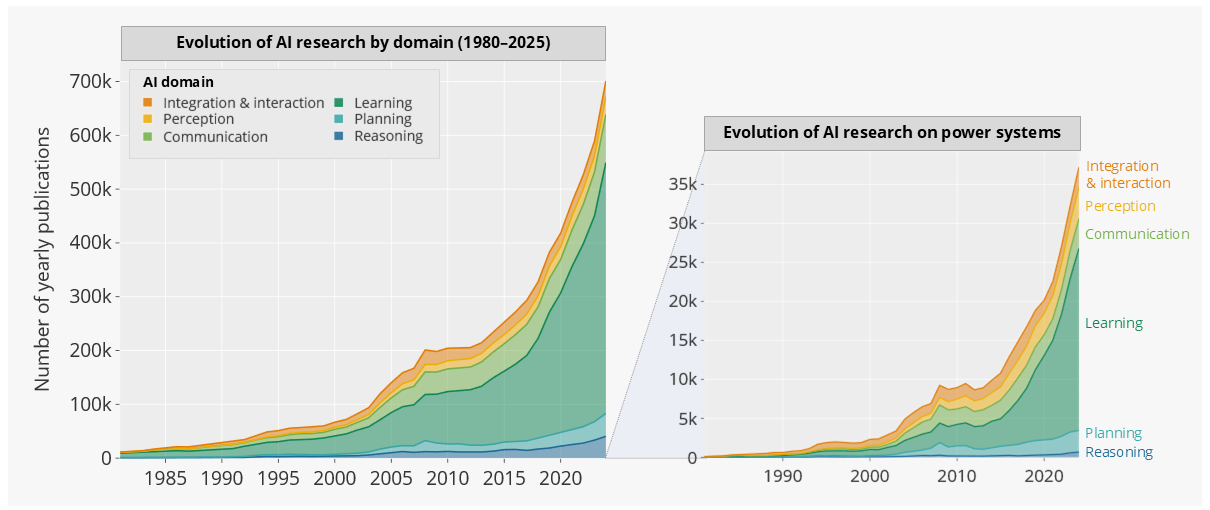
Fig. 1. Evolution of AI research (1980-2025). (Left) Global evolution of AI research by domain, highlighting the dominance of learning-based methods in recent years. (Right) Growth of AI research specifically applied to power systems, showing a sharp acceleration since 2010. Adapted and updated from the Scopus-based analysis.
This growth is clearly visible in research trends (Fig. 1, JRC, 2025[5]). Learning-based methods now dominate AI research overall and account for a large share of work focused specifically on power systems. By 2025, annual publications linking AI and energy exceeded 35,000. Most of this growth sits in practical areas like forecasting, optimisation, system planning, and anomaly detection, reflecting how deeply AI has moved into real-world energy applications.
Key AI Applications Reshaping the Energy Sector
In practice, most AI use in the energy sector falls into three broad areas: system optimisation, asset lifecycle management, and the security and resilience of critical infrastructure.
1. System Optimisation, Trading, and Demand Response
As the share of variable renewable energy (VRE) continues to grow, AI is becoming central to keeping energy systems stable and efficient.
- Forecasting and real-time operations: Machine learning models are now widely used to forecast demand, market prices, and renewable generation with a high degree of accuracy. This improved visibility helps operators spot congestion early, detect abnormal behaviour, and rebalance the system at much shorter timescales than before.
- Reinforcement Learning for grid and market optimisation: Reinforcement learning (RL) is well-suited to sequential decision-making under uncertainty and is increasingly applied to electricity trading and dispatch optimisation (H. Quest et al. 2022[6]). Typical use cases include bidding strategies for aggregated flexible loads, optimisation of microgrids and energy communities, and decision-support tools for transmission system operators.
- Demand response and flexibility: AI is also reshaping demand-side management by learning detailed consumption patterns and optimising load shifting in real time (Schneider Electric, 2024[4]). Large flexible assets, such as commercial buildings or data centres, can be coordinated to behave like virtual power plants. In hyperscale data centres alone, AI-driven dynamic peak shaving could unlock up to 100 GW of flexible capacity worldwide.
2. Asset lifecycle management
AI is increasingly used to improve asset reliability and bring costs down across planning, operations, maintenance, and innovation.
- Predictive maintenance and digital twins: AI-driven predictive maintenance is now well established across generation, transmission, distribution, and microgrids. Digital twins (virtual asset models kept up to date with live data) are used to test scenarios, plan maintenance more effectively, and cut the risk of unplanned outages.
- Battery optimisation and materials innovation: AI speeds up battery research by searching large chemical design spaces for promising materials. In live systems, it is also used to optimise charging strategies, predict degradation, and detect early faults, helping extend asset lifetimes while improving safety
- De-risking construction and permitting: AI tools are starting to play a role in major infrastructure projects, supporting automated document review, geospatial analysis, and smarter permitting workflows. Early deployments report reductions of up to 50% in review times and overall project development costs.
3. AI-Related Cyber Risks and System Resilience
As energy systems become more digital, exposure to cyber risk increases. At the same time, AI is also becoming a key part of how those risks are managed.
- Cybersecurity: Utilities are dealing with growing volumes of increasingly sophisticated cyberattacks. AI supports defence by monitoring network traffic in real time, flagging unusual behaviour, and helping automate incident response.
- AI as both enabler and threat: New regulations, including the EU AI Act, classify many AI systems used in energy safety components as “high risk”, bringing stricter oversight requirements. In parallel, attackers can also use AI to automate and scale cyberattacks, which makes defensive AI even more important
- Resilient physical infrastructure: AI-powered satellite imagery, drones, and IoT sensors can identify physical damage to critical assets far faster than traditional inspections. AI-enhanced weather forecasting also improves system resilience, cutting computation times from hours to minutes.
Guiding AI Adoption Across the Energy Sector
AI has clear potential to reshape the energy sector, but progress depends on moving past broad enthusiasm and towards structured, evidence-led decisions. Energy professionals need more than a sense of what AI can do. They also need to judge which use cases are ready for deployment, can scale across different settings, and meet regulatory expectations.
Clear language and consistent classification matter here. Tools such as the AI for Impact Compass help by assessing applications across three dimensions:
- Quantified impact
- Scalability potential
- Risk
Readiness remains a key factor. The most established applications, including forecasting, predictive maintenance, and electricity trading, often reach TRL 8–9 and deliver measurable operational and financial value. Their maturity reflects how easily they can be tested, validated, and scaled.
Deployment decisions must also factor in regulatory exposure. Many AI systems used in critical infrastructure fall under “high-risk” categories in frameworks such as the EU AI Act 7 (EU, 2024[7]). These classifications bring stricter requirements and can slow adoption, which makes early risk assessment essential.
References
IEA. Energy and AI. https://www.iea.org/reports/energy-and-ai/ (2025).
Heymann, F., Quest, H., Lopez Garcia, T., Ballif, C. & Galus, M. Reviewing 40 years of artificial intelligence applied to power systems – A taxonomic perspective. Energy AI 15, 100322 https://www.sciencedirect.com/science/article/pii/S2666546823000940, (2024)
Deloitte Global. AI for Energy Systems. https://www.deloitte.com/global/en/issues/climate/ai-for-energy-systems.html (2025).
Schneider Electric. AI for Impact: A Method for Guiding AI-Energy Applications. https://www.se.com/ww/en/download/document/TLA_AI_for_Impact/ (2024).
JRC, AI Watch: Defining Artificial Intelligence 2.0. https://ai-watch.ec.europa.eu/publications/ai-watch-defining-artificial-intelligence-20_en (2021).
Quest, H. et al. A 3D indicator for guiding AI applications in the energy sector. Energy AI 9, 100167, https://www.sciencedirect.com/science/article/pii/S2666546822000234, (2022).
European Parliament. Regulation (EU) 2024/1689 of the European Parliament and of the Council - Artificial Intelligence Act (AI Act). https://eur-lex.europa.eu/eli/reg/2024/1689/oj/eng (2024).